Friday, 20 November 2015

YOU ARE NOT SO SMART by David McRaney

You Are Not So Smart: Why You Have Too Many Friends on Facebook, Why Your Memory Is Mostly Fiction, and 46 Other Ways You're Deluding YourselfYou Are Not So Smart: Why You Have Too Many Friends on Facebook, Why Your Memory Is Mostly Fiction, and 46 Other Ways You're Deluding Yourself by David McRaney
My rating: 5 of 5 stars

BOOK DESCRIPTION: How many of your Facebook friends do you think you know? Do you think you’d rush to a stranger’s help when no one else would? Do you think you choose which product to buy based on whether you like it? Do you think you know why you procrastinate? The truth is, you are not so smart. In fact, you’re pretty irrational, just like everyone else. But that’s OK – because that’s all part of being human. In this pithy celebration of self-delusion, David McRaney explores in 48 short chapters, the assorted ways we mislead ourselves everyday. Based on the popular blog, prepare for a whirlwind tour of the latest research in psychology, and to finally discover why we never get round to our New Year resolutions.

MY REVIEW: This book is essential reading for everyone — that is, everyone who considers themselves a flawed human. Those who don’t probably wouldn’t want to read it in case their delusions are shattered. It’s a wonderfully playful look at the ways our brains delude and deceive us. Each chapter starts with a brief statement of a misconception followed by the truth. Then the author provides a simple, fascinating account of the scientific and psychological research that shows how the misconception and the truth are produced by our brains. It’s a very enjoyable read and highly relevant in our contemporary society when there is so much our brains have to work with in deluding us. If you are looking to improve your intellectual humility, this is the book to do it. By the end of the 48 chapters, you won’t trust what your brain is telling you, you’ll be more cautious about what you think you know, and marvel at the highly sophisticated organ you have inside your head. Don’t miss this intriguing, enlightening, easy-to-read book!

View all my reviews

Thursday, 19 November 2015

NOT IN GOD'S NAME by JONATHAN SACKS

Not In God's Name: Confronting Religious ViolenceNot In God's Name: Confronting Religious Violence by Jonathan Sacks
My rating: 5 of 5 stars

BOOK DESCRIPTION: In this powerful and timely book, one of the most admired and authoritative religious leaders of our time tackles the phenomenon of religious extremism and violence committed in the name of God. If religion is perceived as being part of the problem, Rabbi Sacks argues, then it must also form part of the solution. When religion becomes a zero-sum conceit—that is, my religion is the only right path to God, therefore your religion is by definition wrong—and individuals are motivated by what Rabbi Sacks calls “altruistic evil,” violence between peoples of different beliefs appears to be the only natural outcome.

MY REVIEW: NOT IN GOD’S NAME is one of the most profound books I have ever read. Jonathan Sacks provides an incisive analysis of the roots of religious violence and hopeful direction on the way that humanity may move forward in dealing with it. As recent events in France have demonstrated, none of us are immune or protected against the possibility of religious violence. This makes this book relevant to every one of us. Sacks asks in which direction we want to go — the will to power or the will to life? While Sacks is clearly passionate about this global problem, he writes with extraordinary depth and objectivity with a simple power that is difficult to ignore. Sacks calls all people — and particularly those of the Abrahamic religions — to let go of hate and the grasping for power. As Sacks so eloquently observes, No soul was ever saved by hate. No truth was ever proved by violence. No redemption was ever brought by holy war. No religion won the admiration of the world by its capacity to inflict suffering on its enemies. Despite the fact that these things have been endorsed in their time by sincere religious believers, they are a travesty of faith, and until we learn this, religion will remain one of the greatest threats to the peace of the world. NOT IN GOD’S NAME is a must-read for anyone who wants to understand religious violence (better called “altruistic evil”) — and more importantly, what we can do about it.

View all my reviews

Sunday, 1 November 2015

THE GARGOYLE by Andrew Davidson

The GargoyleThe Gargoyle by Andrew Davidson
My rating: 5 of 5 stars

BOOK DESCRIPTION: The mesmerising story of one man's descent into personal hell and his quest for salvation. On a dark road in the middle of the night, a car plunges into a ravine. The driver survives the crash, but his injuries confine him to a hospital burn unit. There the mysterious Marianne Engel, a sculptress of grotesques, enters his life. She insists they were lovers in medieval Germany, when he was a mercenary and she was a scribe in the monastery of Engelthal. As she spins the story of their past lives together, the man's disbelief falters; soon, even the impossible can no longer be dismissed.

MY REVIEW: Brilliant! I was gripped from the first page right through to the end. The two main characters of the story are intriguing and we grow to know them as the story progresses. The two time dimensions are constructed with richness and detail by the author and the psychological dimensions of both characters is superbly developed. The author uses language evocatively. Embedded in the story are deep themes of grief, religion, philosophy, history, love and many more. They are integrated into the story almost seamlessly and never detract from the story. The story is fresh and unpredictable. A great read!

View all my reviews

Friday, 16 October 2015

THE SILENT ONES by William Brodrick

The Silent Ones by William Brodrick
My rating: 3 of 5 stars

BOOK DESCRIPTION: Find out why Harry is prepared to blame an innocent man. That's the thread. Follow it. You'll reach the Silent Ones.
Eleven-year-old Harry Brandwell, obviously in great distress, refuses to talk. What, or who, is holding him back?
When a homeless man arrives unexpectedly at Larkwood Priory, the community welcomes him with open arms. But he isn't what he seems: he knows why Harry won't speak.
Father Anselm finds himself on the trail of an impostor, unaware that he is being drawn into the shadows of a mysterious conspiracy, his reputation for integrity exploited by those closest to him. With his attempts to pursue justice thwarted at every turn, it is clear that there are those who eagerly await his downfall. As he is lured into the courtroom to defend a man he believes to be innocent, Anselm begins to doubt his own judgment.
Meanwhile Harry Brandwell, abandoned and betrayed, has decided to take matters into his own hands. But Anselm is completely unsuspecting. He's in the dark, seeking the Silent Ones . . .

MY REVIEW: The topic is contemporary and disturbing but the story handles the issue gently and sensitively. I liked the story and the clerical detective, but it wasn't riveting. I'm thinking of going back to the beginning of this author's series (The Father Anselm series) to see what the early stories were like -- so this one at least made me interested to pursue Brodrick's work further. Intriguingly, Brodrick was an Augustinian Friar before becoming a barrister - religion and crime make a good combination for dealing with contemporary themes.

View all my reviews

Wednesday, 30 September 2015

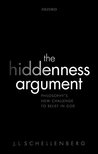
THE HIDDENNESS ARGUMENT: PHILOSOPHY’S NEW CHALLENGE TO BELIEF IN GOD by J L Schellenberg

The Hiddenness Argument: Philosophy's New Challenge to Belief in GodThe Hiddenness Argument: Philosophy's New Challenge to Belief in God by J L Schellenberg
My rating: 4 of 5 stars

BOOK DESCRIPTION: In many places and times, and for many people, God's existence has been rather less than a clear fact. According to the hiddenness argument, this is actually a reason to suppose that it is not a fact at all.

The hiddenness argument is a new argument for atheism that has come to prominence in philosophy over the past two decades. J. L. Schellenberg first developed the argument in 1993, and this book offers a short and vigorous statement of its central claims and ideas. Logically sharp but so clear that anyone can understand, the book addresses little-discussed issues such as why it took so long for hiddenness reasoning to emerge in philosophy, and how the hiddenness problem is distinct from the
problem of evil. It concludes with the fascinating thought that retiring the last of the personal gods might leave us nearer the beginning of religion than the end.

Though an atheist, Schellenberg writes sensitively and with a nuanced insider's grasp of the religious life. Pertinent aspects of his experience as a believer and as a nonbeliever, and of his own engagement with hiddenness issues, are included. Set in this personal context, and against an authoritative background on relevant logical, conceptual, and historical matters, The Hiddenness Argument's careful but provocative reasoning makes crystal clear just what this new argument is and why
it matters.

MY REVIEW: This is one of the freshest, innovative books from an atheist perspective I have read for a long time. Most atheist apologetics rehash the same tired (but no less important) arguments against theism with little new to say. But THE HIDDENNESS ARGUMENT offers a what seems to be a very compelling new argument agains the existence of God. In addition to the presentation of the argument itself, Schellenberg also discusses the nature of good reasoning and logic, providing this important background to readers who may not already know about it. While the book description above suggests that the argument is crystal clear, it will take some readers considerable effort to follow it. But it is worth it. There has also been a plethora of responses from theists critiquing the argument — which I am yet to follow up. If you are interested in the atheist/theist debate, and don’t mind a challenging, provocative read, then check out THE HIDDENNESS ARGUMENT.

View all my reviews

Tuesday, 8 September 2015

THE LOCKET by Adell Harvey

The Locket (Escape from Deseret, #1)The Locket by Adell Harvey
My rating: 3 of 5 stars

BOOK DESCRIPTION: In the late 1850's, thousands of poverty-stricken Scandinavians were lured to America by missionaries of the Latter-day Saints with promises of great prosperity. Ingrid Thirkelsen’s marriage to Brother Rasmussen is as surprising to her as the hope he stirs within. Assigned to the Martin Party of immigrants, she sets out after him, encountering for the first time the horrors of polygamy, blood atonement and blind obedience to cult leaders. As she makes the handcart trek across the Plains and Rocky Mountains, a locket she has promised to deliver in Zion and her Ma's Bible are the only items that give her comfort and the strength to endure the unendurable.

MY REVIEW: The themes in the LOCKET are interesting. Particularly so, given the author has served as a counter-cult missionary in southeast Idaho to Mormons for over 20 years. Some of the former Mormons she has worked with gave her access to their families' genealogical records, diaries and other materials which led to the writing for this book. It's an enjoyable read and the author is clearly committed to accurately portraying the historical events within which her main character, Ingrid, is placed. The problem I have with the book is that it isn't horrifying enough. It seems to me that a lot of Christian writers, because they are writing for Christians (I assume), pull back from making their stories as raw and gritty as they need to be to come across as authentic. When I started the book, I was looking forward to a hard-hitting narrative. But, while it does describe some of the hardships of the immigrants and the cultic doctrines and practices of Mormonism in its early history, it reads too much like a "nice" romance more than anything else. As I read, I couldn't help feeling that the author wasn't quite hitting the right style for material that intends to enlighten the reader on the incredible suffering, particularly of women, during this period of history. So, if you are looking for a light read about some very serious issues, this piece historical fiction might be for you.

NOTE: I received a free copy of this book as part of the LibraryThing Early Reviewers program.

View all my reviews

Tuesday, 1 September 2015

PHILOSOPHY: KEY THEMES by Julian Baggini

Philosophy: Key ThemesPhilosophy: Key Themes by Julian Baggini
My rating: 4 of 5 stars

BOOK DESCRIPTION: Philosophy: Key Themes is a beginner's guide to understanding and critiquing philosophical arguments. Each chapter introduces one of the five major themes covered on philosophy courses: Theory of Knowledge, Moral Philosophy, Philosophy of Religion, Philosophy of Mind, and Political Philosophy. Baggini's approach combines explanation with summary while encouraging the reader to question the arguments and positions presented. This text can be used either independently of, or together with, its companion volume Philosophy: Key Texts.

MY REVIEW: Overall, an excellent introduction to thinking philosophically and the major arguments in the five themes covered. Easy to read and encourages the reader to think critically about ideas and their historical development.

The one disappointing chapter was that on the philosophy of religion. The tone was quite different in this chapter and focused on critiquing the beliefs of Christianity rather than taking a broad approach to the topic like other chapters. The philosophy of religion covers topics like '... alternative beliefs about God, the varieties of religious experience, the interplay between science and religion, the nature and scope of good and evil, and religious treatments of birth, history, and death. The field also includes the ethical implications of religious commitments, the relation between faith, reason, experience and tradition, concepts of the miraculous, the sacred revelation, mysticism, power, and salvation.' (Philosophy of Religion. (n.d.). Philosophy of Religion. Retrieved September 2, 2015, from https://en.wikipedia.org/wiki/Philoso...) However, Baggini doesn't convey this richness and depth in the chapter.

Apart from the chapter on philosophy of religion, this is a very satisfying read. Baggini is an excellent philosopher who is adept at conveying philosophical ideas in language that is accessible to the average educated person. Highly recommended.

View all my reviews